
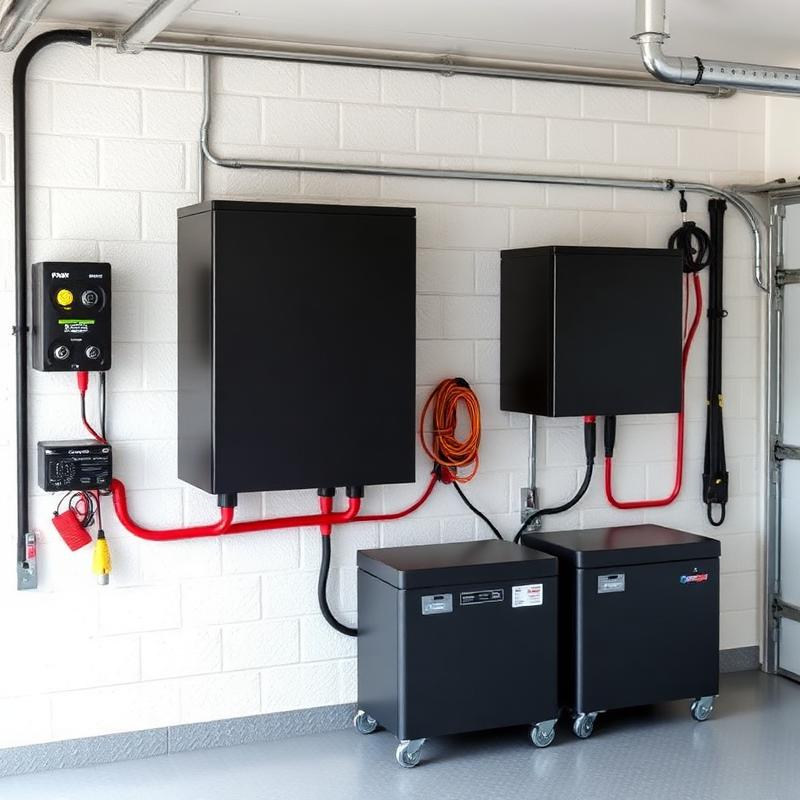
Home Battery Storage in Ireland: Is It Worth Adding to Solar?
Adding a battery to your solar PV system stores excess daytime generation so you can use it in the evening — when grid electricity is most expensive. Battery price depends on capacity, brand and whether it's paired with new solar or retrofitted; we size and quote a fixed price after reviewing your bill and existing inverter.
When a battery makes sense
- You're home in the evenings (highest grid usage)
- You have a smart tariff with cheap night rates
- You want backup power during outages
- You have or plan to add an EV
When it does not
If you use most of your solar during daytime hours (working from home with all appliances running, or pool/spa loads), the export tariff (~20c/kWh) is competitive with battery storage and you may be better off just exporting.
How much does home battery storage cost in Ireland?
Battery pricing depends on usable capacity, whether the inverter is hybrid or AC-coupled, and whether the battery goes in alongside new solar or as a retrofit. Retrofits cost more because they need an additional AC-coupled inverter and often a consumer-unit upgrade. We survey the house, review 12 months of bills and give one fixed price — no hardware price guessing over the phone.
- Installed with new solar PV: cheapest route, one inverter does both jobs
- Retrofit to existing solar: needs an extra inverter, add-on cost
- Battery only (no solar, night-rate arbitrage): viable on time-of-use tariffs
- There is no SEAI grant for battery storage on its own in 2026 — the €1,800 grant covers solar PV
What size battery do Irish homes need?
Size the battery to your evening consumption, not to your roof. Most Irish homes use 4–8 kWh between 4pm and midnight, which is why 5–10 kWh is the normal range. Oversizing means paying for capacity that never cycles — the battery only earns money when it fills and empties most days.
- 3-bed semi, no EV: 5 kWh usable is usually the sweet spot
- 4-bed detached with heat pump: 8–10 kWh
- Home with EV charging overnight: 10 kWh+, or charge the car on the night rate instead
- Want outage backup: you also need a battery and inverter rated for backup circuits
Battery payback maths for 2026
A battery earns the difference between what you would have paid for grid electricity and what the stored unit cost you. Charging from surplus solar you would otherwise export at 18–24c/kWh and using it instead of buying at 35–50c/kWh nets roughly 15–25c per kWh cycled. A 5 kWh battery cycling 4–5 kWh a day for 300 days saves in the region of €300–€550 a year, plus more if you also grid-charge on a cheap night rate over winter.
Home battery storage FAQ
How long does a home battery last? Modern LFP batteries are warrantied for 10 years or 6,000–10,000 cycles, retaining around 70–80% capacity at end of warranty. LFP chemistry is the standard choice in Ireland for safety and cycle life.
Will a battery power my house in a blackout? Only if it is specified for backup and wired to a dedicated backup circuit. Standard grid-tied installs shut down during an outage for safety, so tell us at survey stage if backup matters to you.
Can I add a battery to solar panels installed by someone else? Yes. Most existing systems can be retrofitted with an AC-coupled battery regardless of who installed the panels — we check the existing inverter, cabling and board first.
Do batteries work in winter in Ireland? Solar generation is low from November to February, so in winter the battery earns its keep mainly through night-rate charging and peak avoidance rather than from stored solar.
Estimated figures only. Savings, payback, generation and running-cost numbers shown are indicative estimates, not guarantees. Actual results depend on your system size, roof orientation, shading, electricity tariff, self-consumption, grant eligibility, property condition and other factors. Contact us for a free survey and a fixed, tailored quote.
Get a free quote for your home
SEAI-registered installer. Free survey, free quote, full grant paperwork handled.